XHDATA D-226
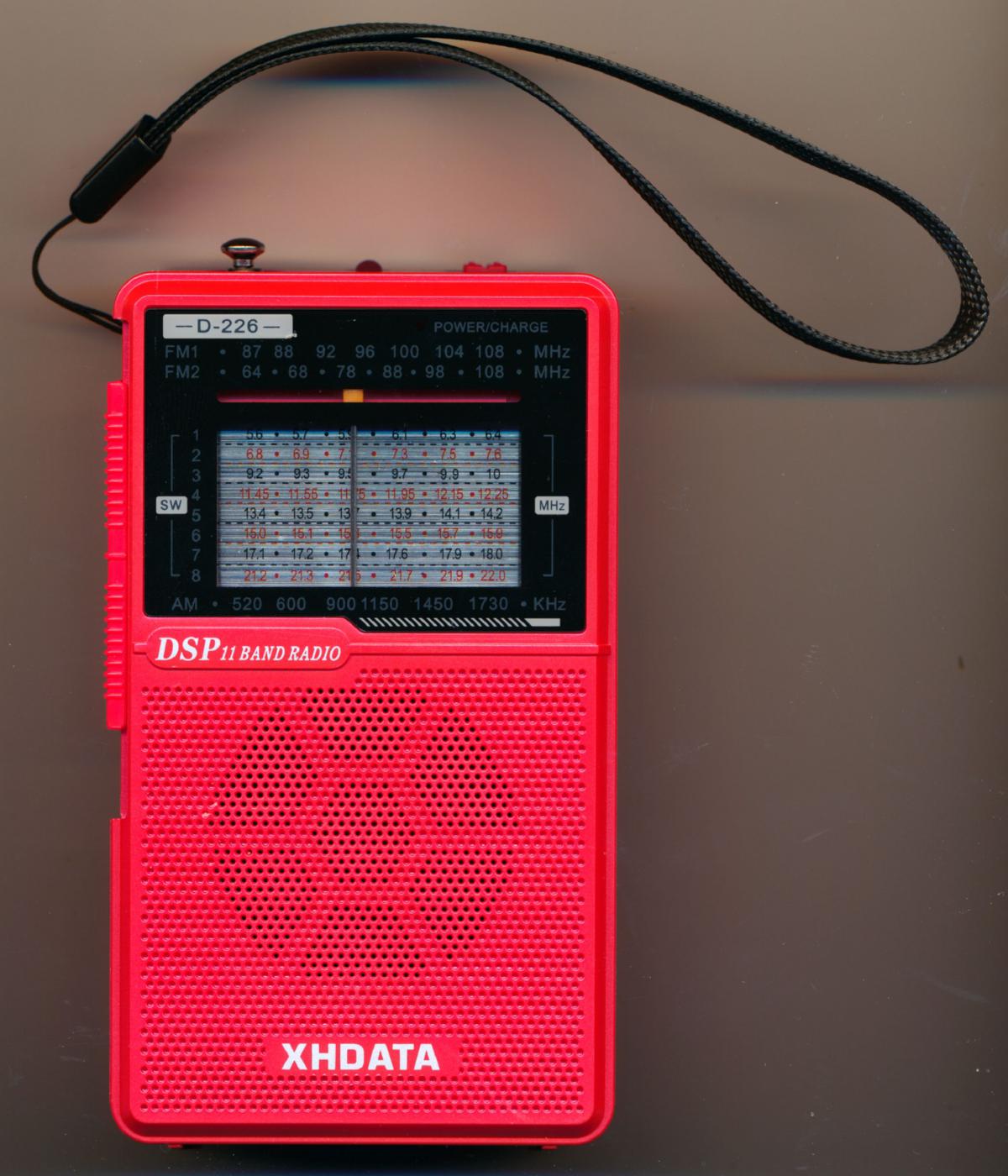
Retro is in. And not just in the world of radios. These days, it’s becoming increasingly common to come across devices that are thoroughly modern and technically up-to-date, yet wrapped in a nostalgic design. Retro—that’s also the first impression you get when you pick up the D-226. It was developed by the Chinese company XHDATA—and, personally, it reminds me of my very first radio. Back in the early ’70s, it was a pocket radio—though it could only receive AM. I’ll show below that the little D-226 is capable of much more.
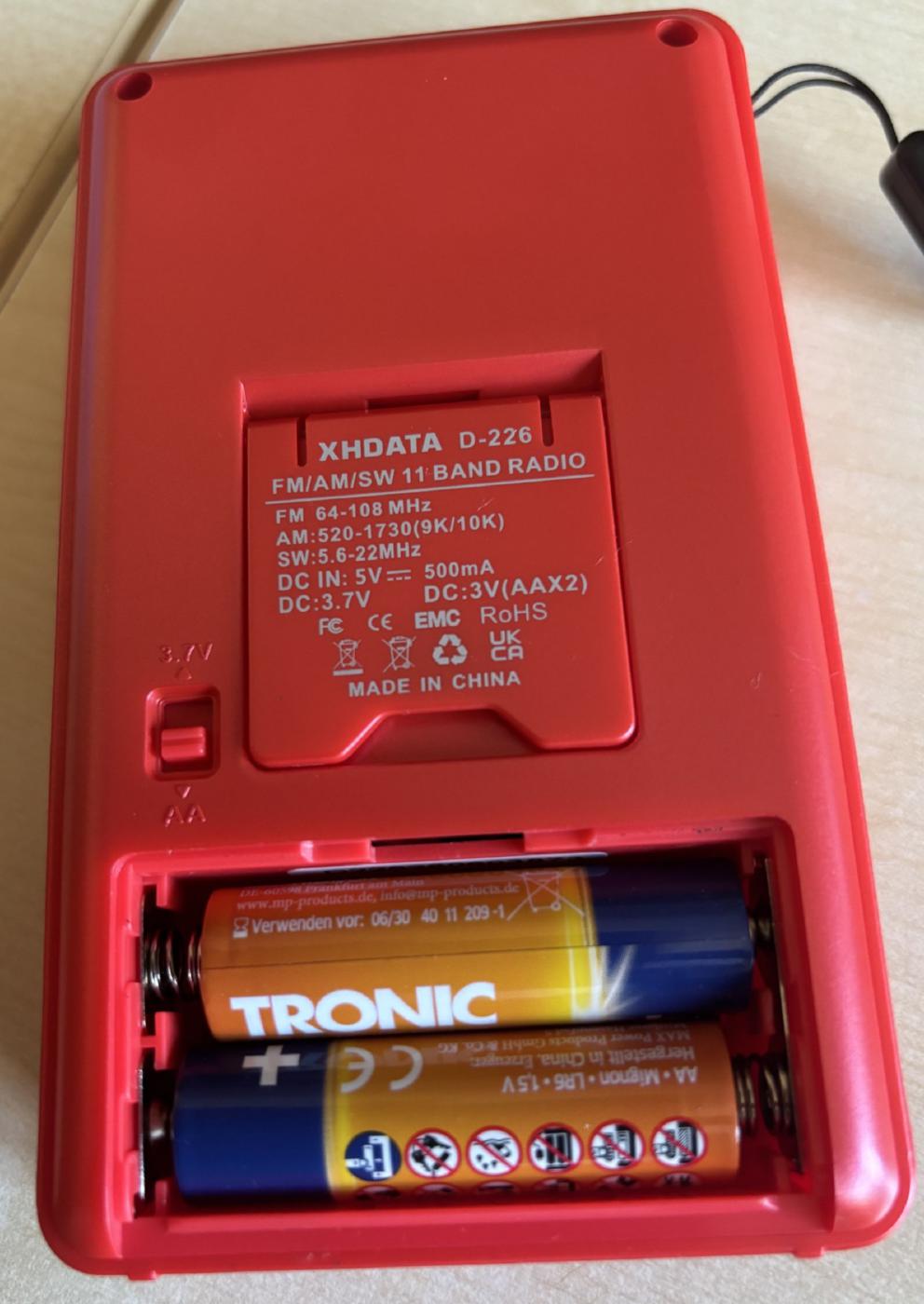
Gray, green, or red are the three colors to choose from. It’s quite possible that more colors will be added later. Small, light, and elegantly designed: This little device, measuring 12.5 × 7 × 2.5 cm, currently costs just under 27 euros in online stores. It’s even cheaper when purchased directly from the manufacturer. A radio for so little money! Is that really possible? Extensive testing has shown that the D-226 not only sounds very good for its size but also delivers truly impressive reception performance. The D-226 requires two AA batteries, which are not included. Both standard disposable batteries and rechargeable 3V batteries can be used. The radio has a battery-charging function—a charging cable is included.
The radio weighs a mere 160 grams. Even with the two AA batteries included, it weighs about 220 grams. It’s ideal for taking along on trips or for relaxing on the patio, balcony, or in the garden. The small emergency light on the top of the unit is particularly handy—especially if the power goes out and you need to find your way in the dark.
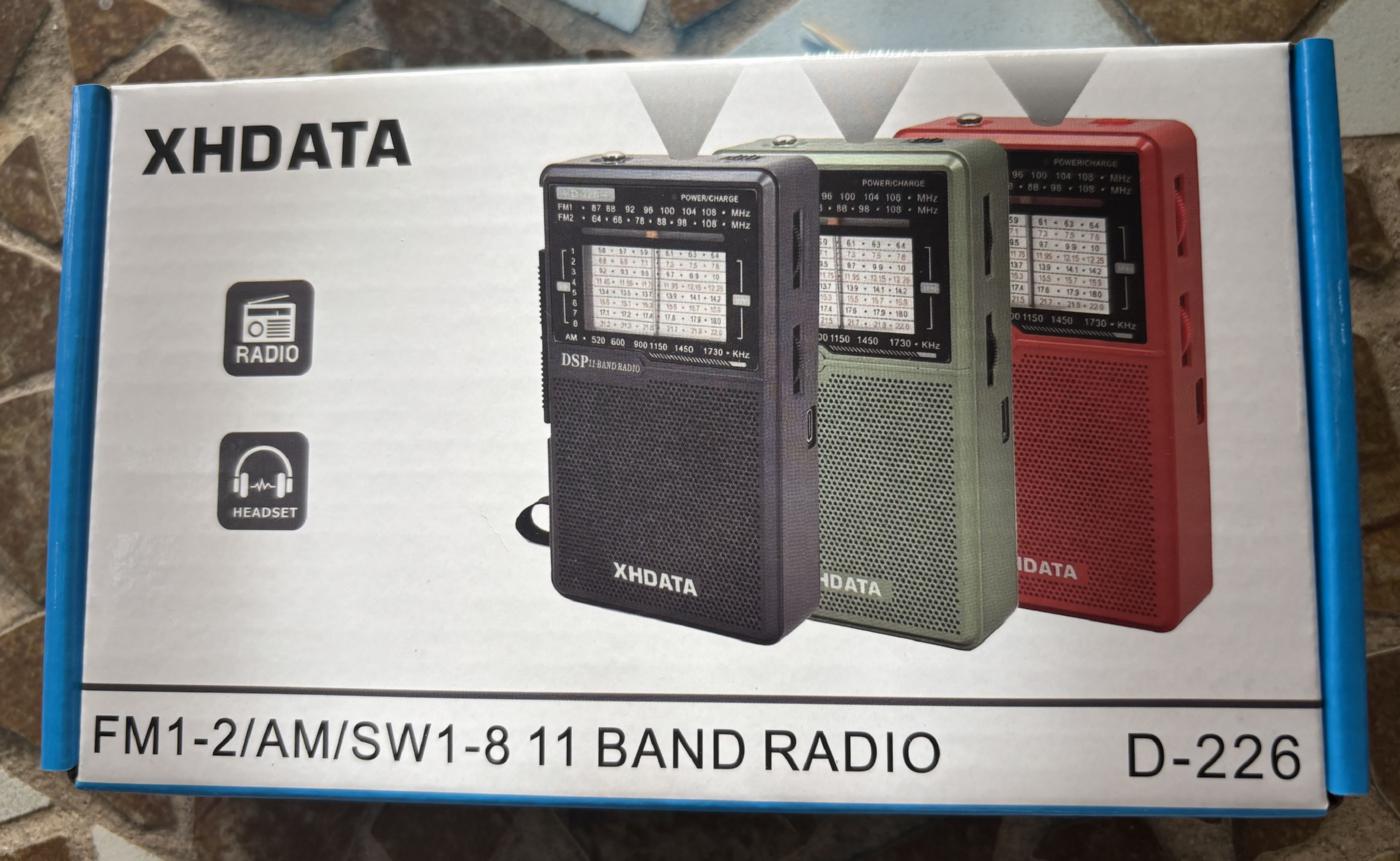
Included is a brief description of the device in English. This data sheet focuses on the essential basics: It highlights the technical specifications, the individual functions and how to use them, as well as the required safety precautions.
There is a sturdy tab in the upper left corner for easy transport. Very user-friendly, there is a flap on the back where you can not only read the device’s most important technical specifications, but which you can also pull out to position the radio at a stable, slightly angled angle.
The small D-226 does not feature digital frequency entry—which, at a price of 27.00 EUR, is not particularly surprising. Tuning in to stations is therefore not quite as easy as it is, for example, with the XHDATA D-808—but it’s still quite manageable. Station search is made easier, particularly on shortwave, by the spread of the bands and their division into eight frequency ranges. The shortwave band covers the frequency range from 5,600 kHz to 22,000 kHz—unfortunately, the 60- and 75-meter bands are not included. Due to the lack of a digital display, finding stations takes a bit of getting used to—but it’s still not too difficult—not least because of the device’s fairly precise frequency tuning.
Technical Specifications
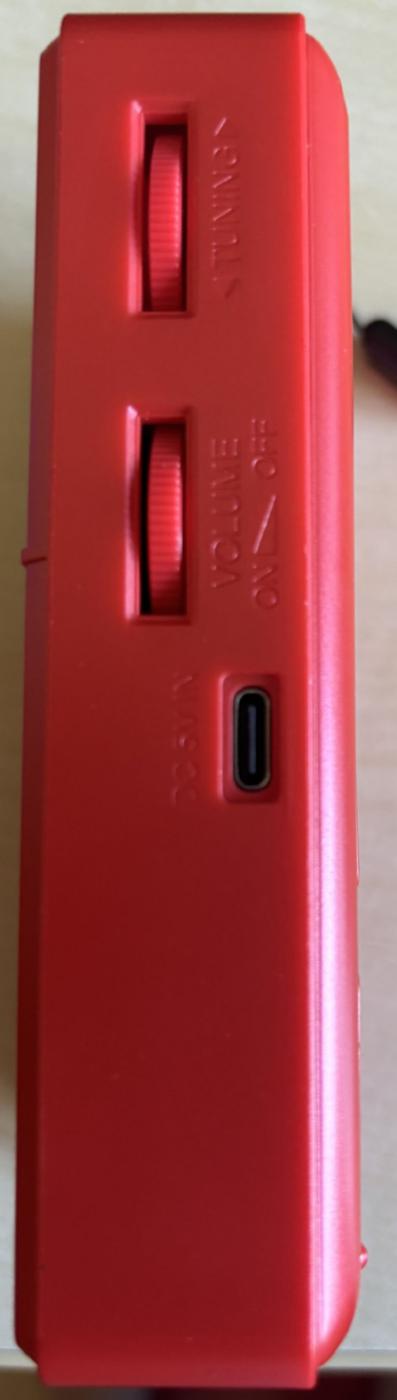
On the top panel, next to the extendable telescopic antenna, you’ll find the emergency light with its on/off switch. For medium-wave reception, the radio has a built-in ferrite antenna—and, of course, a telescopic antenna for FM and shortwave. There’s also a headphone jack and a charging port for the rechargeable batteries—if you’re using them. The device is extremely energy-efficient, so the batteries last quite a long time. On the right is a dial for tuning the stations, and below it is a dial for turning the radio on and off and adjusting the volume. In the lower half is a small but surprisingly powerful speaker; on the left are the scale and the switch for selecting the individual frequency ranges.
FM
FM is available in two bands: FM1 from 87 MHz to 108 MHz and FM2 from 64 MHz to 108 MHz. The lower frequency range is likely to be of particular interest in some Eastern European regions.
FM reception ranges from good to very good. Strong stations are very easy to tune in, while smaller, somewhat weaker stations require a bit more finesse. This is also the case with the other bands.
As reference units, I used the Grundig Satellit 700 for FM and the small Deepelec DP-666, which has very strong FM reception. While the reception performance of the Chinese D-226 doesn’t quite match that of the DP-666, it holds its own quite well against the Grundig Satellit 700. The small D-219 from XHDATA is very similar in reception performance—though tuning stations is slightly easier on the D-226. The sound is surprisingly beautiful and balanced. For example: Deutschlandradio Kultur broadcasts at 200 watts from Berliner Allee in Freiburg im Breisgau and can still be received here in Herbolzheim in northern Breisgau. The same goes for uniFM, which broadcasts from the Freiburg University Hospital at 300 watts. Even Freies Radio Wiesental (500 watts) can be heard, though not entirely free of static. After all, it’s nearly 60 km from here to the transmitter.
Medium Wave
During the day, practically nothing can be heard on the medium-wave bands because only very small stations remain in Germany for this frequency range. However, the situation is quite different after dark. Signals from Eastern Europe, in particular, can be received without any problems using the built-in ferrite antenna. Since Spain has largely abandoned medium wave, for example, BNR Horizont from Bulgaria comes in clearly and without interference here on 576 kHz. But there’s more: Even the museum radio station from Bad Ischl (1,476 kHz with 1 kW) can be received here in Breisgau—and after it goes off the air late in the evening, with a little luck you can even hear the unfamiliar sounds of Radio Keralam from Ras al-Khaima in the United Arab Emirates on the same frequency. The medium wave band spans the range from 520 kHz to 1,730 kHz, so pirate music stations from the Netherlands and Greece can also be heard at night.
Shortwave
Shortwave is divided into eight bands. It’s a bit of a shame that the 75-meter band isn’t included, since not only does the popular Channel 292 broadcast there, but in the evenings, KBS World Radio from Seoul (with a transmitter located in the UK) can also be heard with excellent reception quality.
Thanks to the band spread, the shortwave stations are relatively easy to tune in to—especially for experienced DXers, radio enthusiasts, and shortwave listeners. Shortwave frequencies ranging from 4,750 KHz to 22,000 KHz are available.
Intermediate frequencies such as 6,400 kHz to 6,800 kHz or 10,000 kHz to 11,450 kHz have been omitted because only so-called utility stations can be received there anyway.
The signal performance on the shortwave bands is astonishing. The Grundig Satellit 700 or comparable traditional world receivers simply cannot keep up. For example: at 6,070 kHz, Channel 292 could be received at noon with a weak signal and heavy noise, whereas on the D-226, it came in with a very strong signal and very little noise. The D-226 performed just as impressively on the other shortwave bands. Without a digital display, it does require a bit of a feel for the dial—but you get used to it quickly, and it’s definitely worth it.
Conclusion
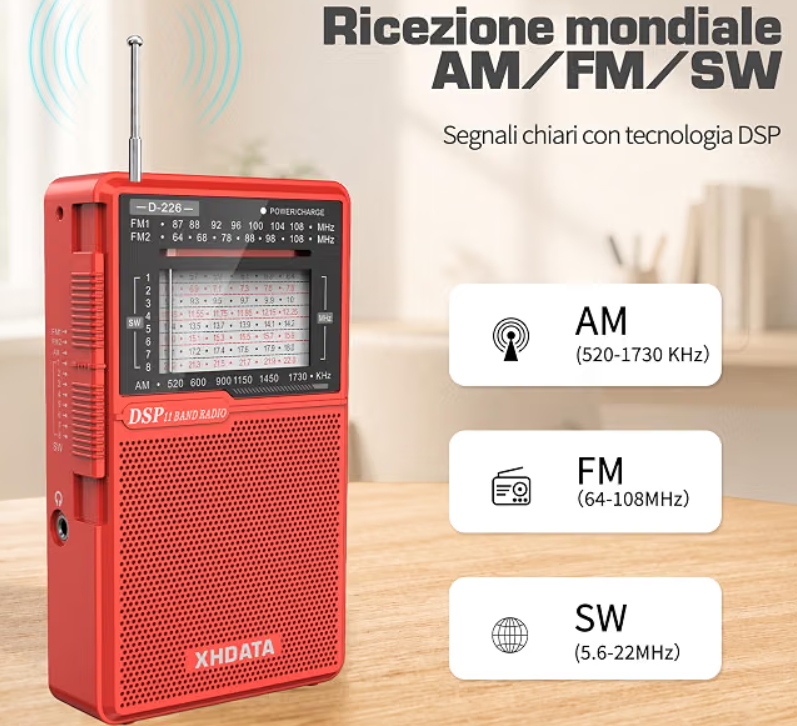
What at first glance looks like an old-fashioned pocket radio is actually a highly sensitive radio with excellent reception—and an impressive sound quality to boot. All in all, with the D-226, XHDATA has developed yet another astonishingly powerful and, in my opinion, visually stunning radio at a very low price. A delicate touch is necessary for smooth operation—but in return, the user is rewarded with truly amazing results. It’s a shame that the 75-meter band is missing. Nevertheless, it’s a lovely radio and, in my opinion, highly recommended. And my very first pocket radio back then was also bright red and beautiful.
Further information is also available directly from the manufacturer:
https://www.xhdata.com.cn/de/products/xhdata-d-226-radio
Retro is in. And not just in the world of radios. These days, it’s becoming increasingly common to come across devices that are thoroughly modern and technically up-to-date, yet wrapped in a nostalgic design. Retro—that’s also the first impression you get when you pick up the D-226. It was developed by the Chinese company XHDATA—and, personally, it reminds me of my very first radio. Back in the early ’70s, it was a pocket radio—though it could only receive AM. I’ll show below that the little D-226 is capable of much more.
Gray, green, or red are the three colors to choose from. It’s quite possible that more colors will be added later. Small, light, and elegantly designed: This little device, measuring 12.5 × 7 × 2.5 cm, currently costs just under 27 euros in online stores. It’s even cheaper when purchased directly from the manufacturer. A radio for so little money! Is that really possible? Extensive testing has shown that the D-226 not only sounds very good for its size but also delivers truly impressive reception performance. The D-226 requires two AA batteries, which are not included. Both standard disposable batteries and rechargeable 3V batteries can be used. The radio has a battery-charging function—a charging cable is included.
The radio weighs a mere 160 grams. Even with the two AA batteries included, it weighs about 220 grams. It’s ideal for taking along on trips or for relaxing on the patio, balcony, or in the garden. The small emergency light on the top of the unit is particularly handy—especially if the power goes out and you need to find your way in the dark.
Included is a brief description of the device in English. This data sheet focuses on the essential basics: It highlights the technical specifications, the individual functions and how to use them, as well as the required safety precautions.
There is a sturdy tab in the upper left corner for easy transport. Very user-friendly, there is a flap on the back where you can not only read the device’s most important technical specifications, but which you can also pull out to position the radio at a stable, slightly angled angle.
The small D-226 does not feature digital frequency entry—which, at a price of 27.00 EUR, is not particularly surprising. Tuning in to stations is therefore not quite as easy as it is, for example, with the XHDATA D-808—but it’s still quite manageable. Station search is made easier, particularly on shortwave, by the spread of the bands and their division into eight frequency ranges. The shortwave band covers the frequency range from 5,600 kHz to 22,000 kHz—unfortunately, the 60- and 75-meter bands are not included. Due to the lack of a digital display, finding stations takes a bit of getting used to—but it’s still not too difficult—not least because of the device’s fairly precise frequency tuning.
Technical Specifications
On the top panel, next to the extendable telescopic antenna, you’ll find the emergency light with its on/off switch. For medium-wave reception, the radio has a built-in ferrite antenna—and, of course, a telescopic antenna for FM and shortwave. There’s also a headphone jack and a charging port for the rechargeable batteries—if you’re using them. The device is extremely energy-efficient, so the batteries last quite a long time. On the right is a dial for tuning the stations, and below it is a dial for turning the radio on and off and adjusting the volume. In the lower half is a small but surprisingly powerful speaker; on the left are the scale and the switch for selecting the individual frequency ranges.
FM
FM is available in two bands: FM1 from 87 MHz to 108 MHz and FM2 from 64 MHz to 108 MHz. The lower frequency range is likely to be of particular interest in some Eastern European regions.
FM reception ranges from good to very good. Strong stations are very easy to tune in, while smaller, somewhat weaker stations require a bit more finesse. This is also the case with the other bands.
As reference units, I used the Grundig Satellit 700 for FM and the small Deepelec DP-666, which has very strong FM reception. While the reception performance of the Chinese D-226 doesn’t quite match that of the DP-666, it holds its own quite well against the Grundig Satellit 700. The small D-219 from XHDATA is very similar in reception performance—though tuning stations is slightly easier on the D-226. The sound is surprisingly beautiful and balanced. For example: Deutschlandradio Kultur broadcasts at 200 watts from Berliner Allee in Freiburg im Breisgau and can still be received here in Herbolzheim in northern Breisgau. The same goes for uniFM, which broadcasts from the Freiburg University Hospital at 300 watts. Even Freies Radio Wiesental (500 watts) can be heard, though not entirely free of static. After all, it’s nearly 60 km from here to the transmitter.
Medium Wave
During the day, practically nothing can be heard on the medium-wave bands because only very small stations remain in Germany for this frequency range. However, the situation is quite different after dark. Signals from Eastern Europe, in particular, can be received without any problems using the built-in ferrite antenna. Since Spain has largely abandoned medium wave, for example, BNR Horizont from Bulgaria comes in clearly and without interference here on 576 kHz. But there’s more: Even the museum radio station from Bad Ischl (1,476 kHz with 1 kW) can be received here in Breisgau—and after it goes off the air late in the evening, with a little luck you can even hear the unfamiliar sounds of Radio Keralam from Ras al-Khaima in the United Arab Emirates on the same frequency. The medium wave band spans the range from 520 kHz to 1,730 kHz, so pirate music stations from the Netherlands and Greece can also be heard at night.
Shortwave
Shortwave is divided into eight bands. It’s a bit of a shame that the 75-meter band isn’t included, since not only does the popular Channel 292 broadcast there, but in the evenings, KBS World Radio from Seoul (with a transmitter located in the UK) can also be heard with excellent reception quality.
Thanks to the band spread, the shortwave stations are relatively easy to tune in to—especially for experienced DXers, radio enthusiasts, and shortwave listeners. Shortwave frequencies ranging from 4,750 KHz to 22,000 KHz are available.
Intermediate frequencies such as 6,400 kHz to 6,800 kHz or 10,000 kHz to 11,450 kHz have been omitted because only so-called utility stations can be received there anyway.
The signal performance on the shortwave bands is astonishing. The Grundig Satellit 700 or comparable traditional world receivers simply cannot keep up. For example: at 6,070 kHz, Channel 292 could be received at noon with a weak signal and heavy noise, whereas on the D-226, it came in with a very strong signal and very little noise. The D-226 performed just as impressively on the other shortwave bands. Without a digital display, it does require a bit of a feel for the dial—but you get used to it quickly, and it’s definitely worth it.
Conclusion
What at first glance looks like an old-fashioned pocket radio is actually a highly sensitive radio with excellent reception—and an impressive sound quality to boot. All in all, with the D-226, XHDATA has developed yet another astonishingly powerful and, in my opinion, visually stunning radio at a very low price. A delicate touch is necessary for smooth operation—but in return, the user is rewarded with truly amazing results. It’s a shame that the 75-meter band is missing. Nevertheless, it’s a lovely radio and, in my opinion, highly recommended. And my very first pocket radio back then was also bright red and beautiful.
Further information is also available directly from the manufacturer:
https://www.xhdata.com.cn/de/products/xhdata-d-226-radio