XHDATA D-808
China has long since become one of the most important countries in the world for DXers and radio enthusiasts. The D-808 from the now-well-known Chinese manufacturer XHDATA has been available for quite some time—and no doubt quite a bit has already been written about it. I was interested in seeing how it stacks up against competitors like the DX-286 from Qodosen or the MLite-880 from Elecevolve. The D-608WB and the compact D-219 from XHDATA were also included in this comparison. Curiosity was my main motivation—and that’s how this review came about.
The XHDATA D-808 comes with a multilingual user manual. Since the German version is incomplete and somehow confusing, I am providing a German-language manual here that is 100% identical to the original.
First Impressions and Basic Functions
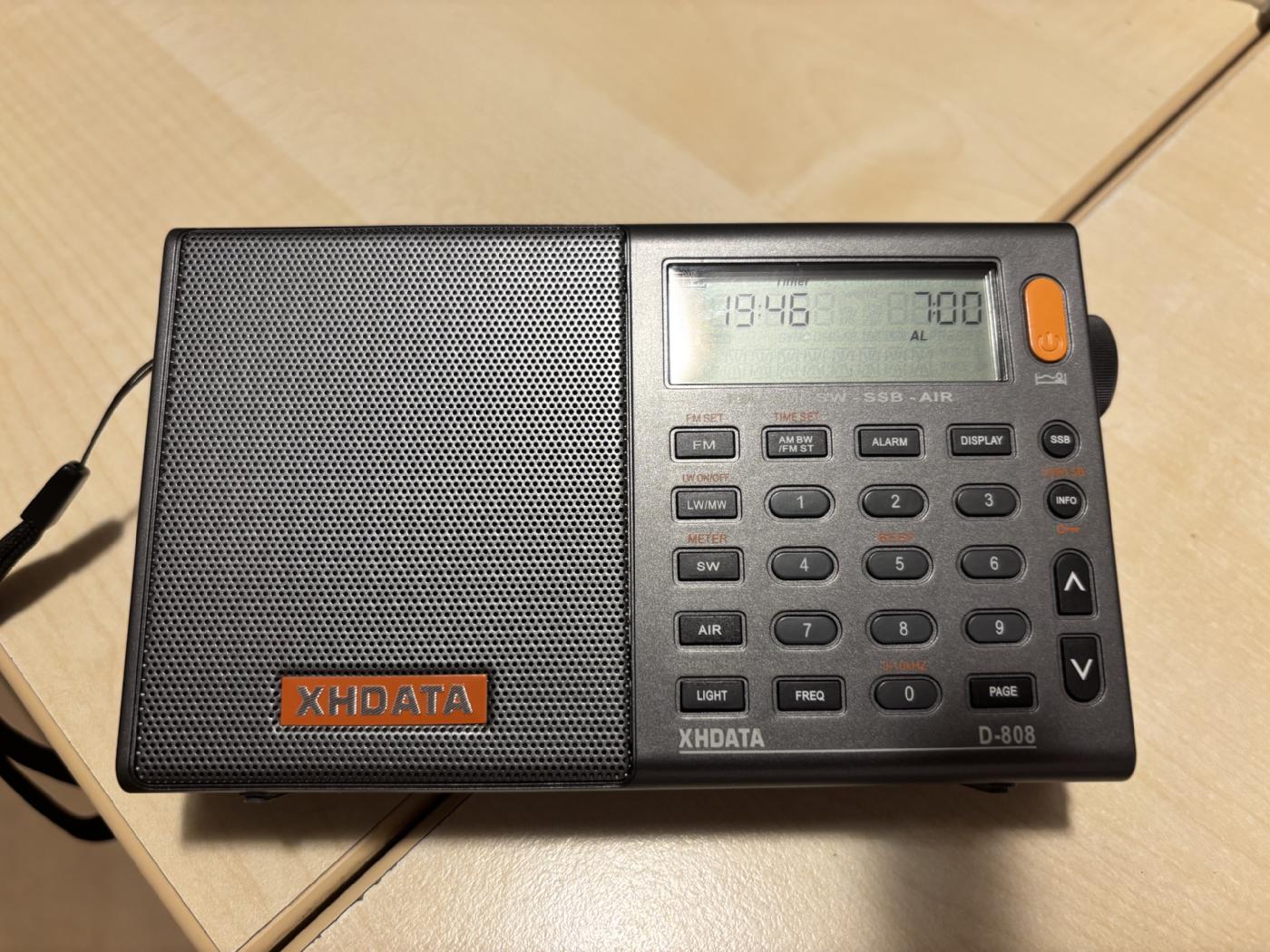
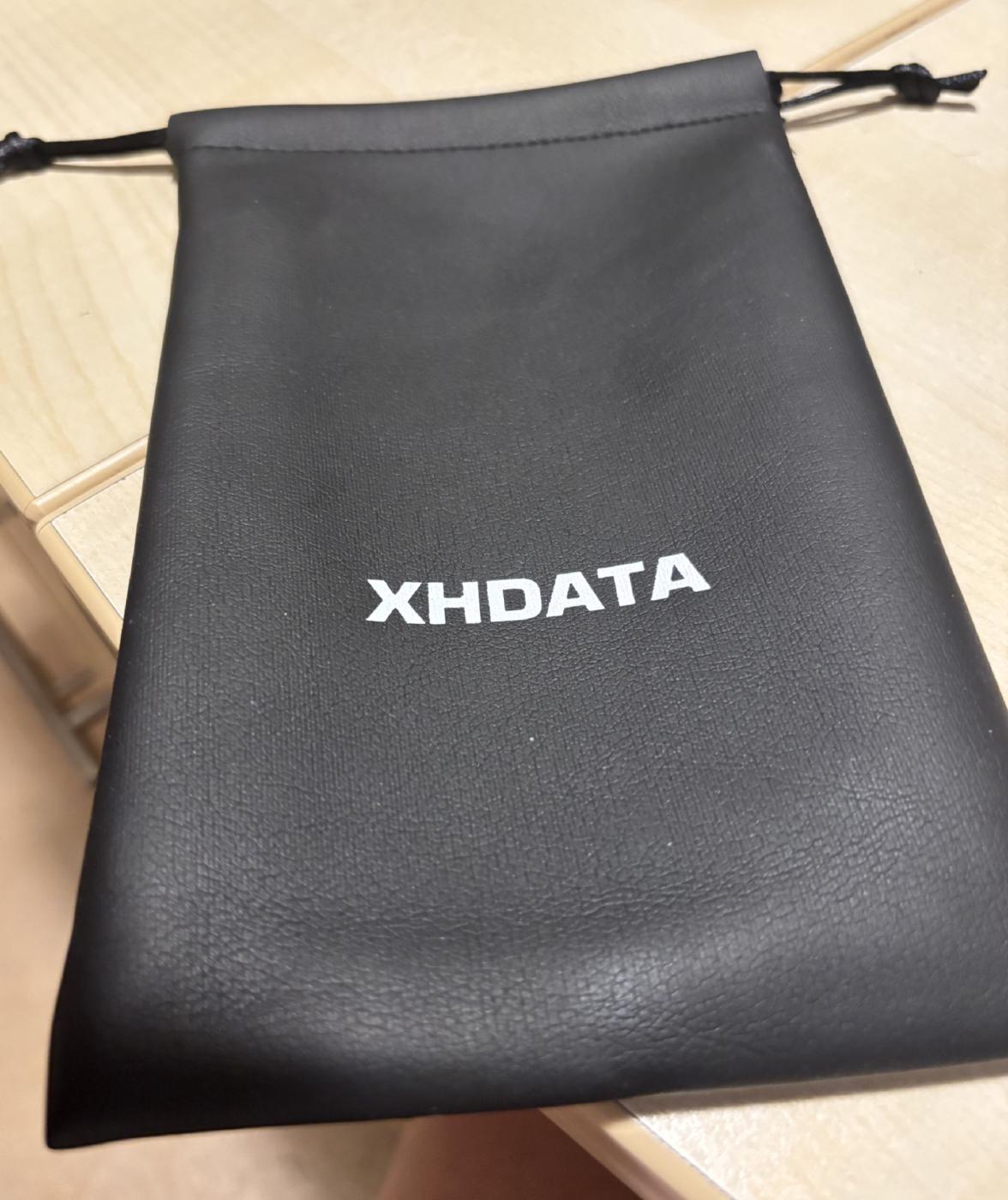
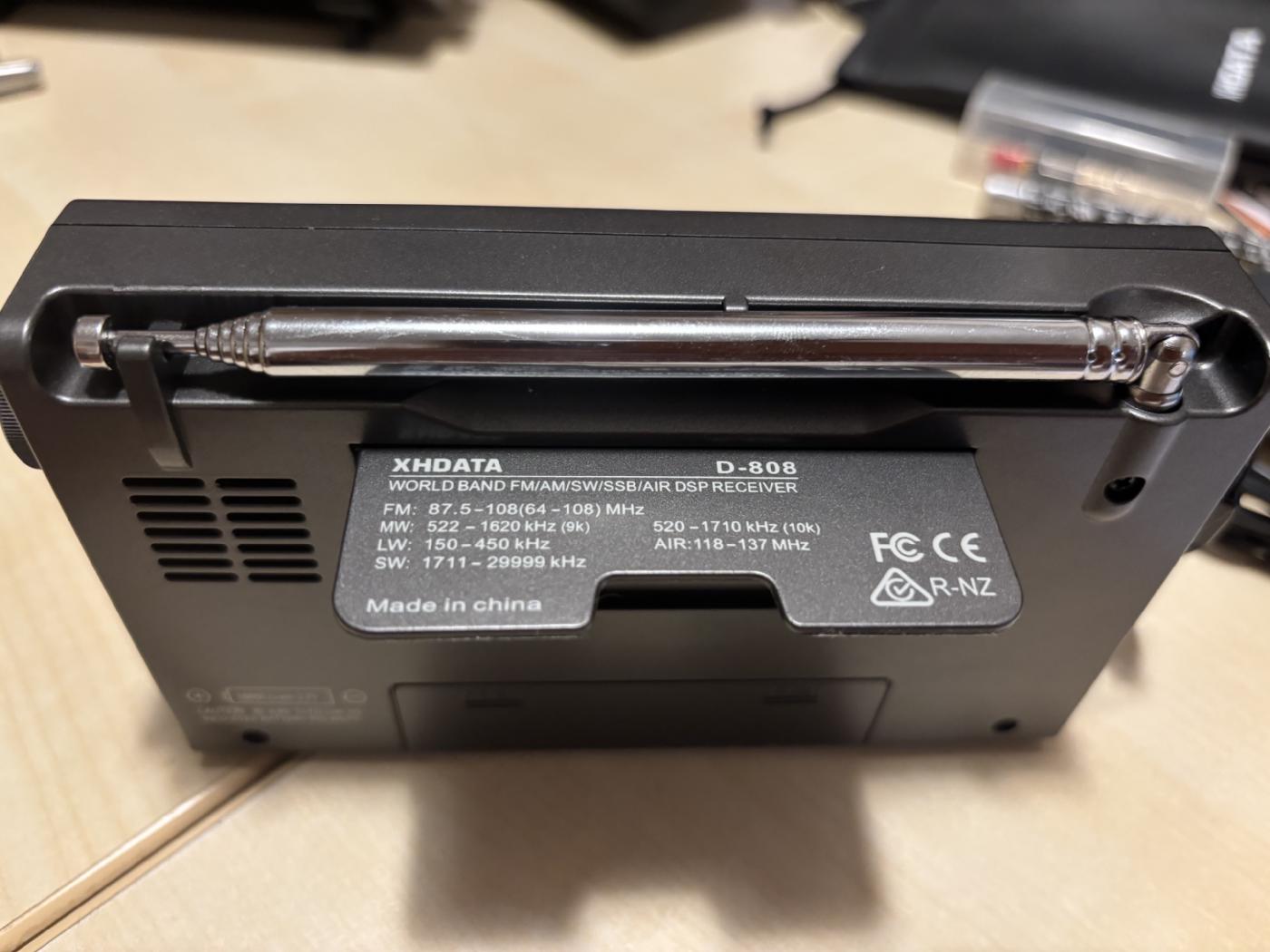
One very positive thing that stands out upon unboxing is that the D-808 comes with a nice carrying case (presumably made of faux leather) and a throw-out antenna. Of course, it also includes a charging cable. It’s particularly pleasing that the throw-out antenna is equipped with a jack plug instead of a clamp and connects to the radio via the designated jack. The in-depth test then revealed the possibilities this offers. At 15 cm x 9 cm x 3 cm, the D-808 is slightly larger than the DX-286 from Qodosen, but it still falls into the “small and ideal for on the go” category. I also really like the look of this little world receiver: the casing and grille are silver-gray, and the brand logo is silver on an orange background. The technical specifications are listed on the DXer-friendly flip-out tab on the back. On the right side of the unit is a multifunction knob. A short press allows you to switch between fast, slow, and stop modes. Pressing and holding for three seconds activates the squelch function, which you can adjust by turning the knob afterward. Also very convenient: For fine tuning, there’s another button located directly below it. On the right side are the volume control knob and the two jack sockets for the external antenna and headphones.
The ergonomic layout of the buttons is striking at first glance: band selection with the buttons on the left, direct frequency entry in the middle, memory and other functions at the top and on the right. Some buttons have additional functions that can only be activated when the device is turned off—these are marked with red text. With these buttons, for example, you can activate longwave, select the respective FM band, turn the “beep” tone on and off, etc.
The German translation of the manual does not mention that the radio also has a temperature display or how to activate it: With the radio turned off, briefly press the “Display” button and then hold down the “3” button for three seconds. If the temperature is then displayed in Fahrenheit, press and hold the “3” button again immediately.
The D-808 offers several search and preset options: Depending on what you’re listening to, you might prefer the ATS search (press and hold the FM button), jumping to the next strong station (arrow buttons), station search via the rotary knob, or direct frequency entry. There’s an option for every situation. This applies to every frequency band. With 500 station presets, that should be more than enough for more than just home use. There are 100 presets for each band—each divided into ten so-called “pages.” Saving a station is very simple: Select a page, then press and hold the desired memory slot (0–9) using the number buttons for three seconds. The previously stored station will be overwritten. To recall a saved station, simply press the desired number—depending on the selected “page.”
The Antennas
For medium- and long-wave reception, the unit features a built-in ferrite antenna that can be adjusted to the station’s frequency by rotating the D-808. Reception sensitivity is quite good and can certainly compete with the comparable devices mentioned. A SONY ICF 7600GR also demonstrated similar performance. The included dipole antenna provided an additional benefit, especially for shortwave reception outdoors—for example, in the garden. Of course, a dedicated outdoor antenna can also be connected to the jack. I tested this as well, with very good results. After dark—and especially in the early morning hours—I was able to receive Radio Caroline on 648 kHz, for example, with virtually no noise or interference. Using my rotatable loop antenna from Wellbrook, I was able to largely filter out Radio Murski Val. Even the rather weak signals from Radio Keralam in Ras al-Khaima on 1476 kHz were audible almost every night after “Museumsradio 1476” went off the air. However, the signal from the United Arab Emirates couldn’t be heard using the internal ferrite antenna or the dipole antenna—though Radio Caroline was audible here in Breisgau, albeit with some noise.
For FM, you normally use the built-in telescopic antenna. An external FM antenna, if available, can of course also be connected.
FM
The frequency spectrum for FM ranges from 64 MHz to 108 MHz. Depending on your preferences or the region you’re in, there are four different FM tuning options, ranging from FM64-108M to FM87.5-108M. You can change the setting at any time with the push of a button.
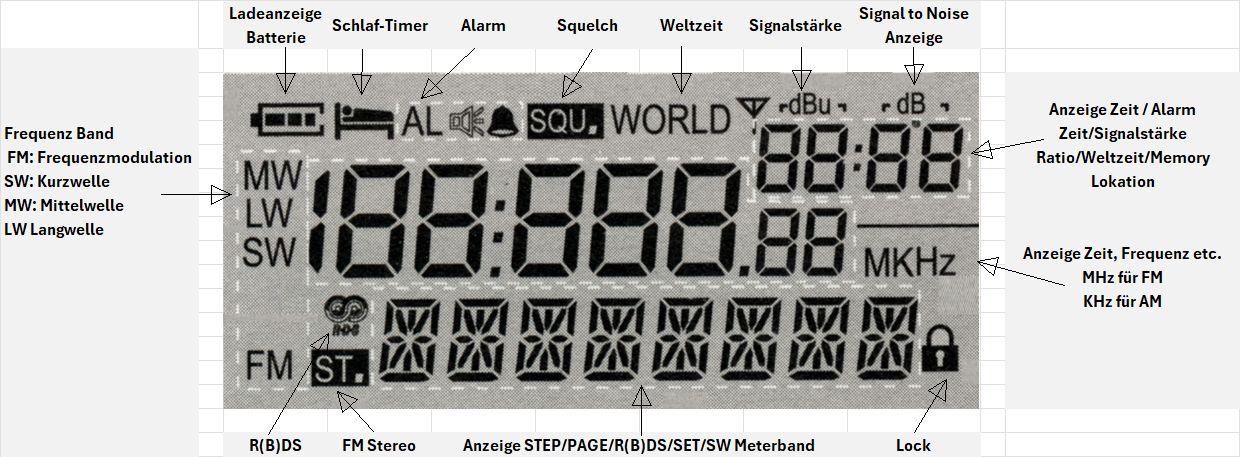
You can also adjust the search mode—that is, the step size—by pressing the search button on the side or, alternatively, using the fine-tuning wheel. You can also enter the desired frequency directly using “Freq.” For example, to set 105.1 MHz, enter: “Freq” + 1051 + “Freq.”
With earphones or headphones connected, you can also listen to stations in stereo. The stereo mode can be turned on or off as desired. Especially with weaker stations, it is recommended to activate mono mode if there is disruptive noise.
Pressing the FM button once briefly switches the device to FM mode. Pressing it for more than 2 seconds starts the station search—saving the found stations if necessary. To enter the station frequency, as described earlier, the user can either enter the corresponding data directly via the numeric keypad. Another option is the rotary knob on the right side, which allows you to switch to the next higher or lower frequency, depending on the preset step size. Additionally, you can tune in to your favorite station using the device’s search and preset functions.
As with other Chinese-made radios, reception performance is very good. The XHDATA D-808 uses the Silicon Labs Si4735 instead of a TEF6686 chip. In fact, this has virtually no effect on reception performance.
I was able to compare both systems. The D-808 is largely on par with the Deepelec DP-666 (which uses the TEF6686) in terms of both signal strength and selectivity—and when it comes to RDS, the D-808 had slight advantages over the DP-666 or the DX-286 from Qodosen. By the way, you can easily switch between the various RDS pages by pressing the “Info” button repeatedly.
Traditional receivers, such as the Grundig Satellit 700 or the Sony ICF 7600GR, are also compatible with the D-808 in the FM band. However, the D-808 does not feature a bandwidth selector.
The sound quality of the stations is surprisingly good considering the size of the unit and its speaker. Here’s another example: “Deutschlandradio Kultur” broadcasts at 200 watts from Berliner Allee in Freiburg im Breisgau and can be received here in Herbolzheim in northern Breisgau without any problems or interference. The same goes for “uniFM,” which broadcasts at 300 watts from the University Hospital in Freiburg. Even “Freies Radio Wiesental,” at 500 watts and 60 km away, could be heard clearly and without static (mono). This isn’t possible with conventional radios.
Long Wave / Medium Wave
Unfortunately, the longwave band is becoming increasingly deserted. Only a few stations can still be heard there today. Nevertheless, it’s great that the D-808 from XHDATA offers this reception option. By default, the longwave band is disabled. If you press and hold the “LW/MW” button for 3 seconds while the radio is turned off, you can turn the longwave band on and off. Adjust the step size on the medium wave using the “0” number key (again, while the radio is turned off). You can always set the frequency manually anyway (direct entry, fine tune). As described above, there is a built-in ferrite antenna for longwave and medium wave. Depending on how the device is oriented, this can improve the station’s signal. As with the other bands, an external antenna can be connected to the designated jack. While the results with the included dipole antenna on longwave and mediumwave were underwhelming, I achieved remarkable reception results with my rotatable Wellbrook loop: For example, the museum station 1476 could be heard without any problems; Radio Eule from Munich on 1500 KHz was still audible, but weak and distorted. Nevertheless, I’m looking forward to the winter season, when overseas reception will be available again.
The SQUELCH function (rotary knob) is very helpful for AM reception. It’s available across the entire AM band. While not really necessary for FM stations, SQUELCH is a great help for long, medium, and shortwave—depending on signal strength—and it’s very pleasant to listen to a station with minimal noise. With very weak signals, however—as is the case with other receivers—the threshold is often set too low, so in such cases it’s not necessarily advisable to activate the SQUELCH.
As is well known, here in Germany there’s nothing to hear on the medium wave band until after dark. The D-808’s medium-wave range extends from 522 to 1710 kHz and can be adjusted from 9 to 10 kHz. The long-wave range extends from 150 kHz to 450 kHz. As is well known, numerous pirate stations—primarily from the Netherlands and Greece—broadcast in the evening hours above 1611 kHz. To listen to these, you must first select the 10-kHz mode (button “0”) and either enter the frequencies directly or use “Fine Tune” to select them.
Overall, the sensitivity and signal separation on longwave and medium wave with the built-in ferrite antenna are decent and comparable, for example, to the Grundig Satellit 700. Unfortunately, a truly interference-free environment indoors is now rare to find. If you connect the D-808 to a good external antenna (such as the Wellbrook Loop), you can pick up a surprising number of stations. Incidentally, this also applies without restriction to shortwave.
Shortwave
The shortwave band ranges seamlessly from 1,711 KHz to 29,999 KHz. Just like the other bands, the shortwave band can be tuned using either the rotary knob or by entering the frequency directly. An automatic station search is available, as are numerous preset options and four-bandwidth switching. SSB also works well, featuring a very convenient auto-search function. When this function is activated for an SSB station, the radio automatically finds the correct setting. Fine tuning is also available, and you can switch back and forth between LSB and USB. Tested and approved.
Reception performance with the built-in telescoping antenna is quite decent in the shortwave range. On all shortwave bands, the noise floor and signal strength with the built-in telescoping antenna are at least on par with the Grundig Satellit 700 or the Sony ICF 7600 GR—with what feels like a slight edge for the little D-808.
For shortwave as well, the unit offers the option to connect an external antenna to the jack—which actually opens up further, amazing possibilities. A real-world example: When I connect the unit to my rotatable Wellbrook Loop rooftop antenna, even weaker stations become clearly audible. For instance, “Channel 292” at 6070 KHz—which is otherwise somewhat noisy—can be heard wonderfully clearly. WWCR from Nashville, TN, on 4840 KHz also sounded very clean, for example, during the morning hours. Overall, the D-808, when connected to the Wellbrook Loop, can certainly hold its own against its bigger brothers.
On shortwave, the included dipole antenna can be put to good use. Especially outdoors, but also in rooms with little interference, it allows you to pick up many stations that would otherwise be drowned out by noise. In particular, 6070 kHz, 6140 kHz, and even international broadcasts from Ankara, Vietnam, etc., are often received with a really good signal when using the external dipole antenna.
The AIR Band
Mit dem XHDATA D-808 kann auch das AIR-Band empfangen werden. Sogar mit ATS. Das ist vor allem dann interessant, wenn man sich in der Nähe eines Flughafens befindet - was hier bei mir leider nicht der Fall ist. Einige Signale sind aber dennoch hörbar, in aller Regel Flieger, die sich gerade in Reichweite befinden. Eine detaillierte Analyse des Flughafenempfangs kann ich nicht liefern, aber doch lässt sich auch hier einiges empfangen. Für so ein kleines Gerät kann es sehr viel. Wie der D-808 im Vergleich mit Flugscannern abschneidet, kann ich nicht beurteilen, weil ich solche nicht besitze.
Conclusion
The XHDATA D-808 is a beautiful, easy-to-use portable radio with many excellent features. It may not be an absolute high-end device, but it wasn’t designed to be one either. It’s highly recommended in any case—wonderful for on the go and traveling—and it even comes equipped with RDS and SSB. The device performs particularly well when paired with a high-quality external antenna, especially in the shortwave band. But you can still pick up a lot of stations even with the included dipole antenna. Bottom line: A really good radio for a small price!
China has long since become one of the most important countries in the world for DXers and radio enthusiasts. The D-808 from the now-well-known Chinese manufacturer XHDATA has been available for quite some time—and no doubt quite a bit has already been written about it. I was interested in seeing how it stacks up against competitors like the DX-286 from Qodosen or the MLite-880 from Elecevolve. The D-608WB and the compact D-219 from XHDATA were also included in this comparison. Curiosity was my main motivation—and that’s how this review came about.
The XHDATA D-808 comes with a multilingual user manual. Since the German version is incomplete and somehow confusing, I am providing a German-language manual here that is 100% identical to the original.
First Impressions and Basic Functions
One very positive thing that stands out upon unboxing is that the D-808 comes with a nice carrying case (presumably made of faux leather) and a throw-out antenna. Of course, it also includes a charging cable. It’s particularly pleasing that the throw-out antenna is equipped with a jack plug instead of a clamp and connects to the radio via the designated jack. The in-depth test then revealed the possibilities this offers. At 15 cm x 9 cm x 3 cm, the D-808 is slightly larger than the DX-286 from Qodosen, but it still falls into the “small and ideal for on the go” category. I also really like the look of this little world receiver: the casing and grille are silver-gray, and the brand logo is silver on an orange background. The technical specifications are listed on the DXer-friendly flip-out tab on the back. On the right side of the unit is a multifunction knob. A short press allows you to switch between fast, slow, and stop modes. Pressing and holding for three seconds activates the squelch function, which you can adjust by turning the knob afterward. Also very convenient: For fine tuning, there’s another button located directly below it. On the right side are the volume control knob and the two jack sockets for the external antenna and headphones.
The ergonomic layout of the buttons is striking at first glance: band selection with the buttons on the left, direct frequency entry in the middle, memory and other functions at the top and on the right. Some buttons have additional functions that can only be activated when the device is turned off—these are marked with red text. With these buttons, for example, you can activate longwave, select the respective FM band, turn the “beep” tone on and off, etc.
The German translation of the manual does not mention that the radio also has a temperature display or how to activate it: With the radio turned off, briefly press the “Display” button and then hold down the “3” button for three seconds. If the temperature is then displayed in Fahrenheit, press and hold the “3” button again immediately.
The D-808 offers several search and preset options: Depending on what you’re listening to, you might prefer the ATS search (press and hold the FM button), jumping to the next strong station (arrow buttons), station search via the rotary knob, or direct frequency entry. There’s an option for every situation. This applies to every frequency band. With 500 station presets, that should be more than enough for more than just home use. There are 100 presets for each band—each divided into ten so-called “pages.” Saving a station is very simple: Select a page, then press and hold the desired memory slot (0–9) using the number buttons for three seconds. The previously stored station will be overwritten. To recall a saved station, simply press the desired number—depending on the selected “page.”
The Antennas
For medium- and long-wave reception, the unit features a built-in ferrite antenna that can be adjusted to the station’s frequency by rotating the D-808. Reception sensitivity is quite good and can certainly compete with the comparable devices mentioned. A SONY ICF 7600GR also demonstrated similar performance. The included dipole antenna provided an additional benefit, especially for shortwave reception outdoors—for example, in the garden. Of course, a dedicated outdoor antenna can also be connected to the jack. I tested this as well, with very good results. After dark—and especially in the early morning hours—I was able to receive Radio Caroline on 648 kHz, for example, with virtually no noise or interference. Using my rotatable loop antenna from Wellbrook, I was able to largely filter out Radio Murski Val. Even the rather weak signals from Radio Keralam in Ras al-Khaima on 1476 kHz were audible almost every night after “Museumsradio 1476” went off the air. However, the signal from the United Arab Emirates couldn’t be heard using the internal ferrite antenna or the dipole antenna—though Radio Caroline was audible here in Breisgau, albeit with some noise.
For FM, you normally use the built-in telescopic antenna. An external FM antenna, if available, can of course also be connected.
FM
The frequency spectrum for FM ranges from 64 MHz to 108 MHz. Depending on your preferences or the region you’re in, there are four different FM tuning options, ranging from FM64-108M to FM87.5-108M. You can change the setting at any time with the push of a button.
You can also adjust the search mode—that is, the step size—by pressing the search button on the side or, alternatively, using the fine-tuning wheel. You can also enter the desired frequency directly using “Freq.” For example, to set 105.1 MHz, enter: “Freq” + 1051 + “Freq.”
With earphones or headphones connected, you can also listen to stations in stereo. The stereo mode can be turned on or off as desired. Especially with weaker stations, it is recommended to activate mono mode if there is disruptive noise.
Pressing the FM button once briefly switches the device to FM mode. Pressing it for more than 2 seconds starts the station search—saving the found stations if necessary. To enter the station frequency, as described earlier, the user can either enter the corresponding data directly via the numeric keypad. Another option is the rotary knob on the right side, which allows you to switch to the next higher or lower frequency, depending on the preset step size. Additionally, you can tune in to your favorite station using the device’s search and preset functions.
As with other Chinese-made radios, reception performance is very good. The XHDATA D-808 uses the Silicon Labs Si4735 instead of a TEF6686 chip. In fact, this has virtually no effect on reception performance.
I was able to compare both systems. The D-808 is largely on par with the Deepelec DP-666 (which uses the TEF6686) in terms of both signal strength and selectivity—and when it comes to RDS, the D-808 had slight advantages over the DP-666 or the DX-286 from Qodosen. By the way, you can easily switch between the various RDS pages by pressing the “Info” button repeatedly.
Traditional receivers, such as the Grundig Satellit 700 or the Sony ICF 7600GR, are also compatible with the D-808 in the FM band. However, the D-808 does not feature a bandwidth selector.
The sound quality of the stations is surprisingly good considering the size of the unit and its speaker. Here’s another example: “Deutschlandradio Kultur” broadcasts at 200 watts from Berliner Allee in Freiburg im Breisgau and can be received here in Herbolzheim in northern Breisgau without any problems or interference. The same goes for “uniFM,” which broadcasts at 300 watts from the University Hospital in Freiburg. Even “Freies Radio Wiesental,” at 500 watts and 60 km away, could be heard clearly and without static (mono). This isn’t possible with conventional radios.
Long Wave / Medium Wave
Unfortunately, the longwave band is becoming increasingly deserted. Only a few stations can still be heard there today. Nevertheless, it’s great that the D-808 from XHDATA offers this reception option. By default, the longwave band is disabled. If you press and hold the “LW/MW” button for 3 seconds while the radio is turned off, you can turn the longwave band on and off. Adjust the step size on the medium wave using the “0” number key (again, while the radio is turned off). You can always set the frequency manually anyway (direct entry, fine tune). As described above, there is a built-in ferrite antenna for longwave and medium wave. Depending on how the device is oriented, this can improve the station’s signal. As with the other bands, an external antenna can be connected to the designated jack. While the results with the included dipole antenna on longwave and mediumwave were underwhelming, I achieved remarkable reception results with my rotatable Wellbrook loop: For example, the museum station 1476 could be heard without any problems; Radio Eule from Munich on 1500 KHz was still audible, but weak and distorted. Nevertheless, I’m looking forward to the winter season, when overseas reception will be available again.
The SQUELCH function (rotary knob) is very helpful for AM reception. It’s available across the entire AM band. While not really necessary for FM stations, SQUELCH is a great help for long, medium, and shortwave—depending on signal strength—and it’s very pleasant to listen to a station with minimal noise. With very weak signals, however—as is the case with other receivers—the threshold is often set too low, so in such cases it’s not necessarily advisable to activate the SQUELCH.
As is well known, here in Germany there’s nothing to hear on the medium wave band until after dark. The D-808’s medium-wave range extends from 522 to 1710 kHz and can be adjusted from 9 to 10 kHz. The long-wave range extends from 150 kHz to 450 kHz. As is well known, numerous pirate stations—primarily from the Netherlands and Greece—broadcast in the evening hours above 1611 kHz. To listen to these, you must first select the 10-kHz mode (button “0”) and either enter the frequencies directly or use “Fine Tune” to select them.
Overall, the sensitivity and signal separation on longwave and medium wave with the built-in ferrite antenna are decent and comparable, for example, to the Grundig Satellit 700. Unfortunately, a truly interference-free environment indoors is now rare to find. If you connect the D-808 to a good external antenna (such as the Wellbrook Loop), you can pick up a surprising number of stations. Incidentally, this also applies without restriction to shortwave.
Shortwave
The shortwave band ranges seamlessly from 1,711 KHz to 29,999 KHz. Just like the other bands, the shortwave band can be tuned using either the rotary knob or by entering the frequency directly. An automatic station search is available, as are numerous preset options and four-bandwidth switching. SSB also works well, featuring a very convenient auto-search function. When this function is activated for an SSB station, the radio automatically finds the correct setting. Fine tuning is also available, and you can switch back and forth between LSB and USB. Tested and approved.
Reception performance with the built-in telescoping antenna is quite decent in the shortwave range. On all shortwave bands, the noise floor and signal strength with the built-in telescoping antenna are at least on par with the Grundig Satellit 700 or the Sony ICF 7600 GR—with what feels like a slight edge for the little D-808.
For shortwave as well, the unit offers the option to connect an external antenna to the jack—which actually opens up further, amazing possibilities. A real-world example: When I connect the unit to my rotatable Wellbrook Loop rooftop antenna, even weaker stations become clearly audible. For instance, “Channel 292” at 6070 KHz—which is otherwise somewhat noisy—can be heard wonderfully clearly. WWCR from Nashville, TN, on 4840 KHz also sounded very clean, for example, during the morning hours. Overall, the D-808, when connected to the Wellbrook Loop, can certainly hold its own against its bigger brothers.
On shortwave, the included dipole antenna can be put to good use. Especially outdoors, but also in rooms with little interference, it allows you to pick up many stations that would otherwise be drowned out by noise. In particular, 6070 kHz, 6140 kHz, and even international broadcasts from Ankara, Vietnam, etc., are often received with a really good signal when using the external dipole antenna.
The AIR Band
Mit dem XHDATA D-808 kann auch das AIR-Band empfangen werden. Sogar mit ATS. Das ist vor allem dann interessant, wenn man sich in der Nähe eines Flughafens befindet - was hier bei mir leider nicht der Fall ist. Einige Signale sind aber dennoch hörbar, in aller Regel Flieger, die sich gerade in Reichweite befinden. Eine detaillierte Analyse des Flughafenempfangs kann ich nicht liefern, aber doch lässt sich auch hier einiges empfangen. Für so ein kleines Gerät kann es sehr viel. Wie der D-808 im Vergleich mit Flugscannern abschneidet, kann ich nicht beurteilen, weil ich solche nicht besitze.
Conclusion
The XHDATA D-808 is a beautiful, easy-to-use portable radio with many excellent features. It may not be an absolute high-end device, but it wasn’t designed to be one either. It’s highly recommended in any case—wonderful for on the go and traveling—and it even comes equipped with RDS and SSB. The device performs particularly well when paired with a high-quality external antenna, especially in the shortwave band. But you can still pick up a lot of stations even with the included dipole antenna. Bottom line: A really good radio for a small price!