Choyong LC100
Radio is my passion. It has been a part of my life for as long as I can remember. Even back then, when I was taking my first steps into the world at home with my dad’s old tube radio, the radio had become a gateway to the world for me.
Who would have thought back then of all the possibilities we have today? Choyong has been on the European radio market for several years now. The products on display in Choyong’s radio shop are truly remarkable: Take the “Voyager,” for example—probably the world’s smallest internet radio. Clad in genuine nappa leather, the Maestro delivers a rich sound spectrum—and, to my knowledge, the LC90 was the world’s first world receiver featuring internet radio, a TF card, eSIM, and more.
Now Choyong has unveiled a radio that surpasses everything we’ve seen so far in many ways: The LC100—the successor to the already very capable LC90—is available in two versions: One version features DAB+ and was developed specifically for the European market and Brazil. The second version, which lacks DAB+ but is equipped with the TEF6686 chip, is intended for all those parts of the world where DAB+ is not available—and for dedicated FM wave hunters. The information provided here refers to the European version with DAB+.
Since there is currently no German-language user manual available, I am making it available here on my website.
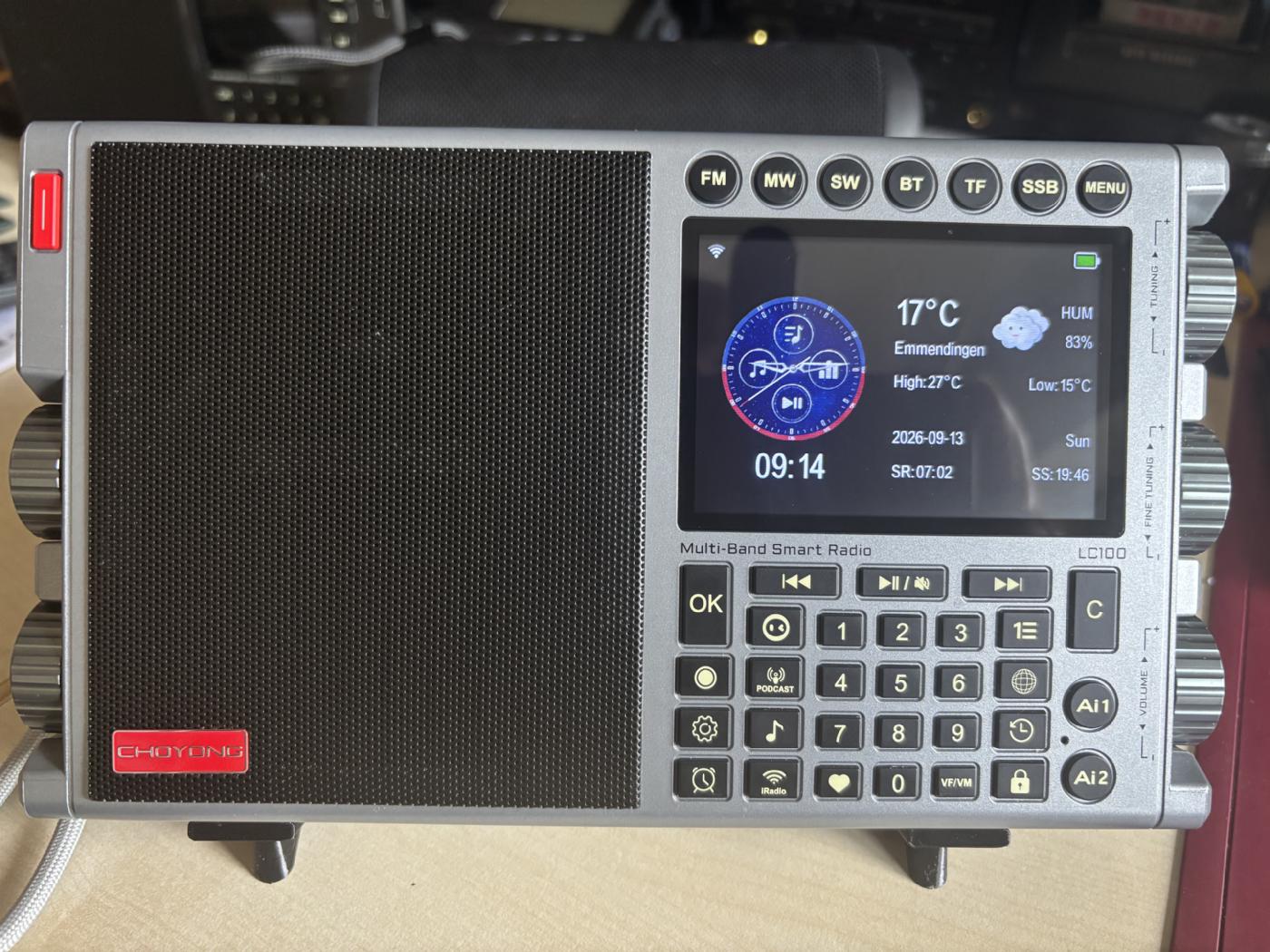
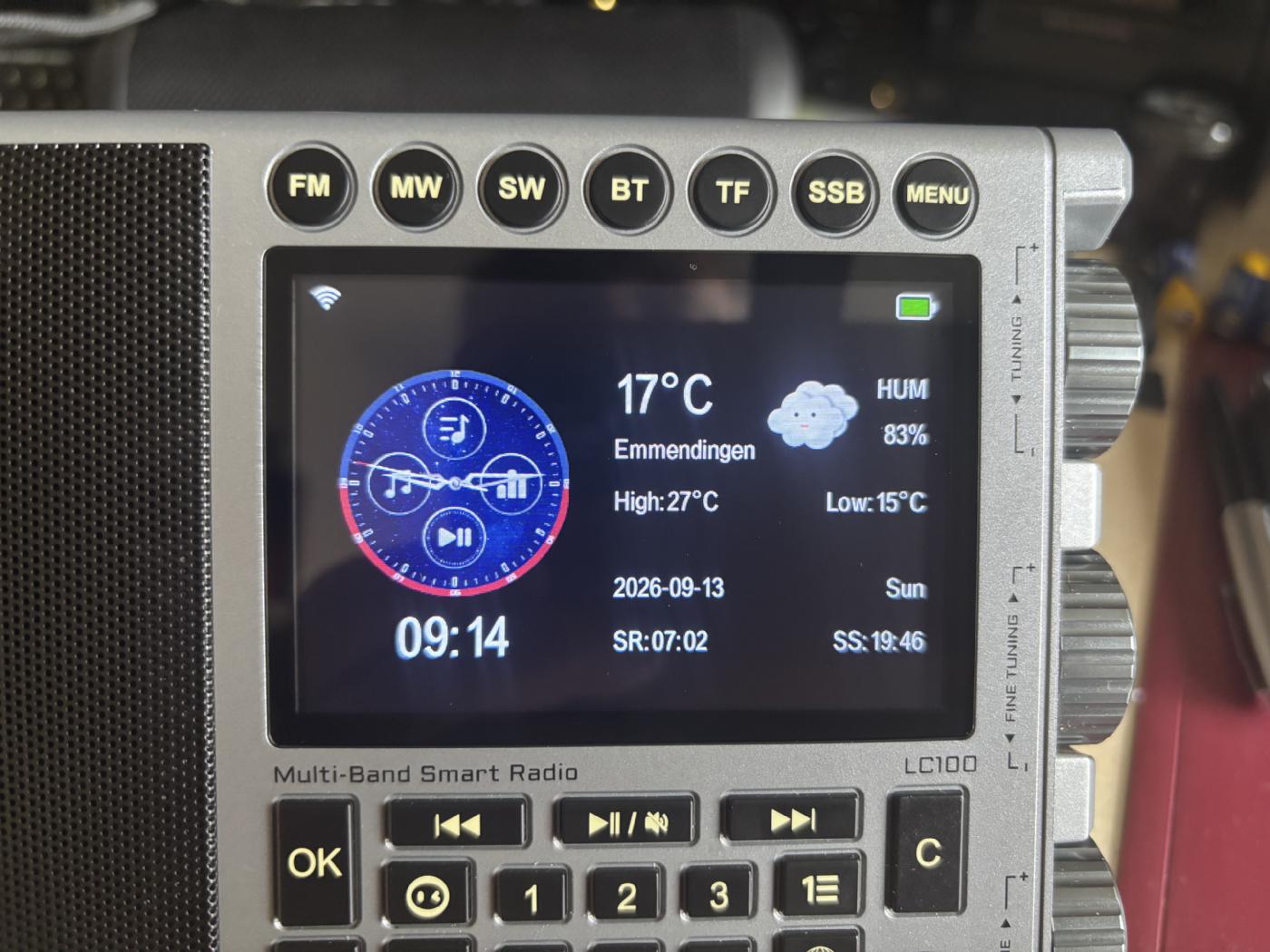
The LC100 also comes in two different versions in terms of its exterior design: The all-black version resembles its predecessor, the LC90, in some respects. Personally, I particularly like the LC100 in the silver finish. While the LC90’s multifunctional knobs protrude from the right side of the device, they are integrated into the housing on the new LC100. In addition, there are now two knobs on the left side that allow the treble and bass to be adjusted independently of each other. A whole range of new features has been added, which will be discussed in detail below. The significantly larger display is particularly impressive. The radio detects its local location and displays the time, temperature, humidity, and sunrise and sunset times from the nearest weather station.
Not long ago, the LC90 was the world’s first radio to offer all the key features of a world receiver while also serving as a modern internet radio with podcasts, Bluetooth, and voice control. Firmware updates, which Choyong provides to its customers free of charge, also transformed the radio into an interactive jukebox—an audio device where you simply say the song title or the artist’s name, and the radio plays the track. Added to this were user interfaces in multiple languages, including German. With the LC100, there is now a radio that combines all these features. The German user interface will also be available soon. It’s impossible to summarize all the new features in just a few words. For the first time, there is now a world receiver with DAB+, a music box function, internet radio, podcasts, voice input, Bluetooth, a time archive, a recorder, and much more.
Internet Radio & Podcasts
Once you turn on the radio, you can immediately access the device’s analog functions: longwave, mediumwave, shortwave, and FM. However, to access online stations, the device must first connect to Wi-Fi and the internet—just like with the LC90—which can take a few seconds. The Wi-Fi capabilities have been significantly improved and accelerated compared to the LC90—and both Wi-Fi bands can now be used. Alternatively, you can also operate the LC100 with a SIM or eSIM. You can order the eSIM directly from Choyong, allowing the radio to function fully even without your own internet modem. Choyong maintains its own database where the online radio stations are hosted—and is therefore not reliant on third-party providers, which tend to disappear from the scene from time to time. The selection is enormous, and the stability is far greater than with any other provider. There are around 50,000 stations to choose from. If, despite the variety, you can’t find a specific station, you can easily add it yourself via an online interface. The stations are sorted by continent and country. German stations are organized by federal state. National stations, such as DLF and public broadcasters, are available in their own separate categories. In addition to the many internet radio stations, listeners will find a nearly limitless number of podcasts. You can select your preferred podcast language—including German—via the menu. For added convenience, there’s also a “Music” button to help you find stations or podcasts. The menu also allows you to select stations by categories such as “Interviews,” “Music,” “Technology,” and much more. And that’s not all: the LC100 also features voice control. This lets you “talk” to the radio and simply “call up” the station or podcast you want without having to type or fiddle with the controls. Commands like “BBC” or “Kontrafunk” search for stations and display them in a list of results, from which you can then select the station you want. To be fair, it should be noted that voice control doesn’t always work right away—which is sometimes due to the spoken word not always being interpreted correctly. Every now and then, it helped if I repeated the station name or said it in English. The sound quality of the LC100 is excellent—especially thanks to the new ability to adjust treble and bass separately and tailor the sound to your own preferences—always, of course, depending on the data rate of the currently tuned station.
A new feature on the LC100 is the option to access regionally available internet stations using a dedicated iRadio button. This is controlled via the device’s location search.
Stations you particularly enjoy and listen to frequently can be marked as favorites using the heart button and saved to a separate list, which can then be accessed via the “Menu” button. This also works for songs, podcasts, and analog services.
The Radio as a Jukebox
After pressing the Menu button and then “Search,” you can use voice input to start your search. First, you’ll need to decide whether you want to search for stations (Ai2), podcasts (Ai1), or music (MENU). Hold down the corresponding button, and when the microphone icon on the display starts flashing, say the name of the artist or composer you want to hear, then release the button. You should pronounce the name as clearly as possible, though—sometimes the name isn’t recognized. If the artist is found, the LC90 turns into a real music machine. You can choose from the selected artist’s repertoire—or simply let it play one track after another—automatically. The heart icon lets you save your selection as a favorite and recall it later by pressing the heart button. Over time, you can build up a real music library this way.
Bluetooth, TF, and Recorder Function
Once you’ve paired your radio with a Bluetooth device—such as a cell phone—you become your own program director and can conveniently play music files or YouTube audio. With the added ability to store and play music, podcasts, audiobooks, and more on a TF card, the possibilities offered by the radio are virtually limitless. The TF card must be formatted as FAT. According to the specifications, cards up to 32 GB are supported. In practice, however, much larger cards also work—I’ve personally tested a card with a full TB and had no issues.
The LC100 can now also record music tracks and DAB broadcasts. The tracks can then be easily edited and trimmed on a PC and compiled into your own playlist or CD. The recorder also works flawlessly with podcasts. This feature is not yet available for analog services such as shortwave (SW), medium wave (MW), or FM. If you press the record button in standby mode, ambient sounds are recorded—and you can even “speak into the recorder” yourself.
The Radio as a Time Machine
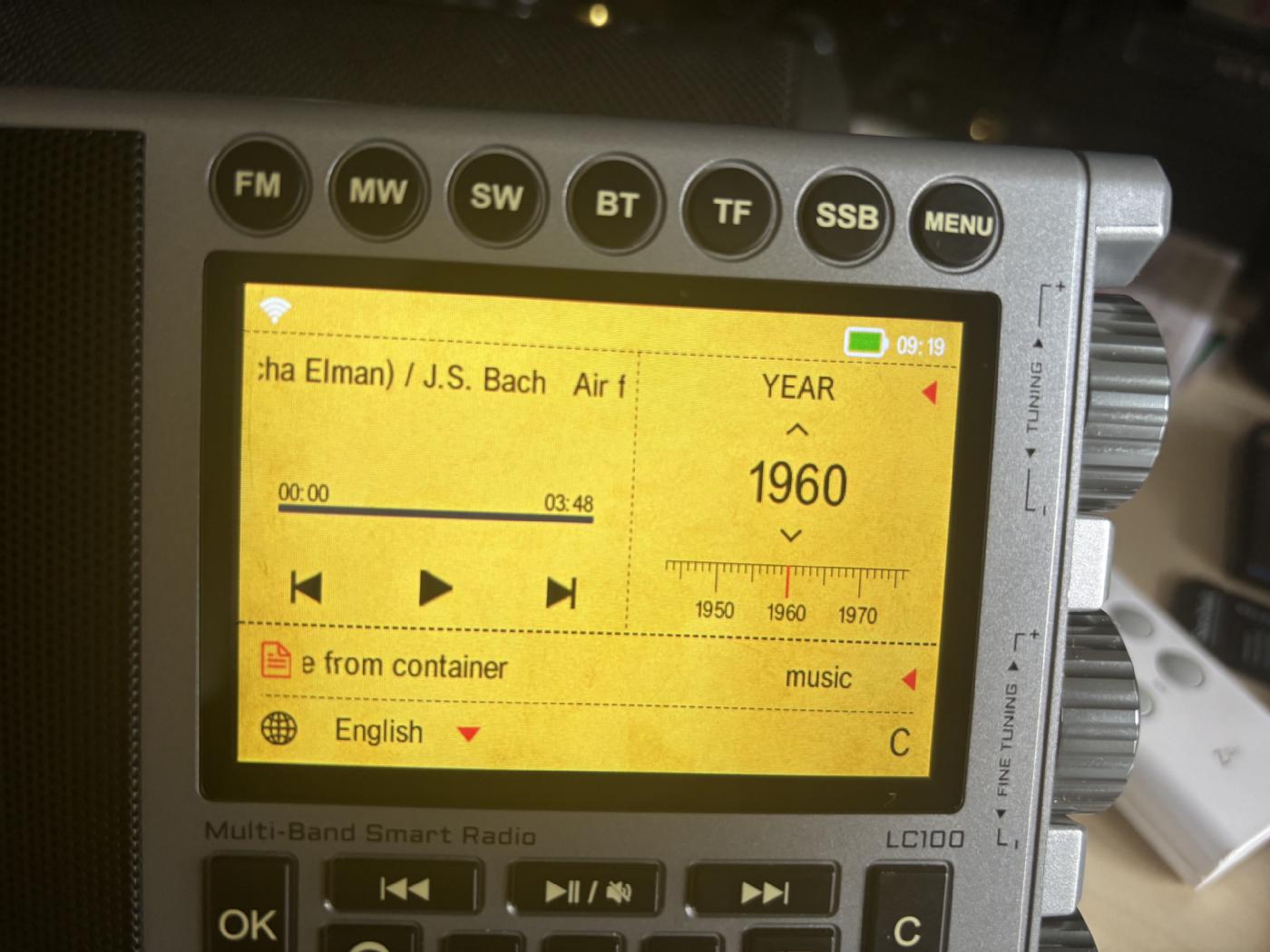
You’re in for a real surprise when you select the “Time Archive” option from the menu. The LC100’s display transforms, turning the radio into a real time machine. Here’s how it works: Use “OK” to select the language you want, and while holding down the “Tuning” knob, choose the year you’d like to travel to. Behind this feature is online.org, a massive collection of historical documents from the past. The journey through time begins in 1900 and ends today. Recordings from the selected year are then played at random. In addition to music, speeches, and sound recordings, you can also listen to entire radio plays and broadcasts. The selection is random, so you can look forward to new sounds every time. The display shows the selected year and language, as well as the currently playing track, the track’s duration, the audio type, and details about the track. You can use the forward, reverse, and pause buttons to navigate, skip tracks, or listen to them repeatedly.
After the welcome message, the display occasionally shows a timeout message following the initial startup, which you can skip by briefly pressing the “C” button.
FM
The FM frequency range extends from 64 MHz to 108 MHz—adjustable in 50, 100, and 200 kHz increments. You can also enter the frequency directly using the number pads. To set 88.5 MHz, enter 885 and wait 1 second; the frequency will then be active. The bandwidth can be widened or narrowed (while holding down the fine-tuning knob) from 56 to 311 kHz—depending on whether you want to listen to a particularly weak or a strong local station. Of course, you can also simply set it to “Auto,” which works almost every time.
For my tests and comparisons, I used the Grundig Satellit700 and the small Deepelec DP-666—which has excellent FM reception—as reference units. The LC100’s reception performance is indeed very good. It’s amazing what this unit can pick up with its 110-cm-long telescoping antenna. Even the Deepelec DP-666, with its TEF6686 chip, can’t keep up. And the Grundig Satellit700 certainly can’t. The sound quality of the stations played back is brilliant—especially at high bandwidth. In this regard, the Choyong LC100 is far superior to both reference units. The ability to individually adjust the treble and bass settings also has a very positive effect here.
Example: “Deutschlandradio Kultur” broadcasts at 200 watts from Berliner Allee in Freiburg im Breisgau and can be received here in Herbolzheim in northern Breisgau without any problems or interference. The same goes for “uniFM,” which broadcasts from the Freiburg University Hospital at 300 watts. Even “Freies Radio Wiesental,” broadcasting at 500 watts from 60 km away, was heavily noisy and plagued by interference on the DP-666, but came through crystal clear on the LC100 with a 56 kHz bandwidth. On the Grundig, the station was completely inaudible.
I particularly like the RDS feature on the LC100. I don’t know of any other radio that recognizes the name of the station being listened to in RDS so quickly. If the signal is strong enough, it takes no more than a second for the RDS name to appear on the display. After a brief wait, the program type appears, and finally, if available, the song currently playing.
DAB+
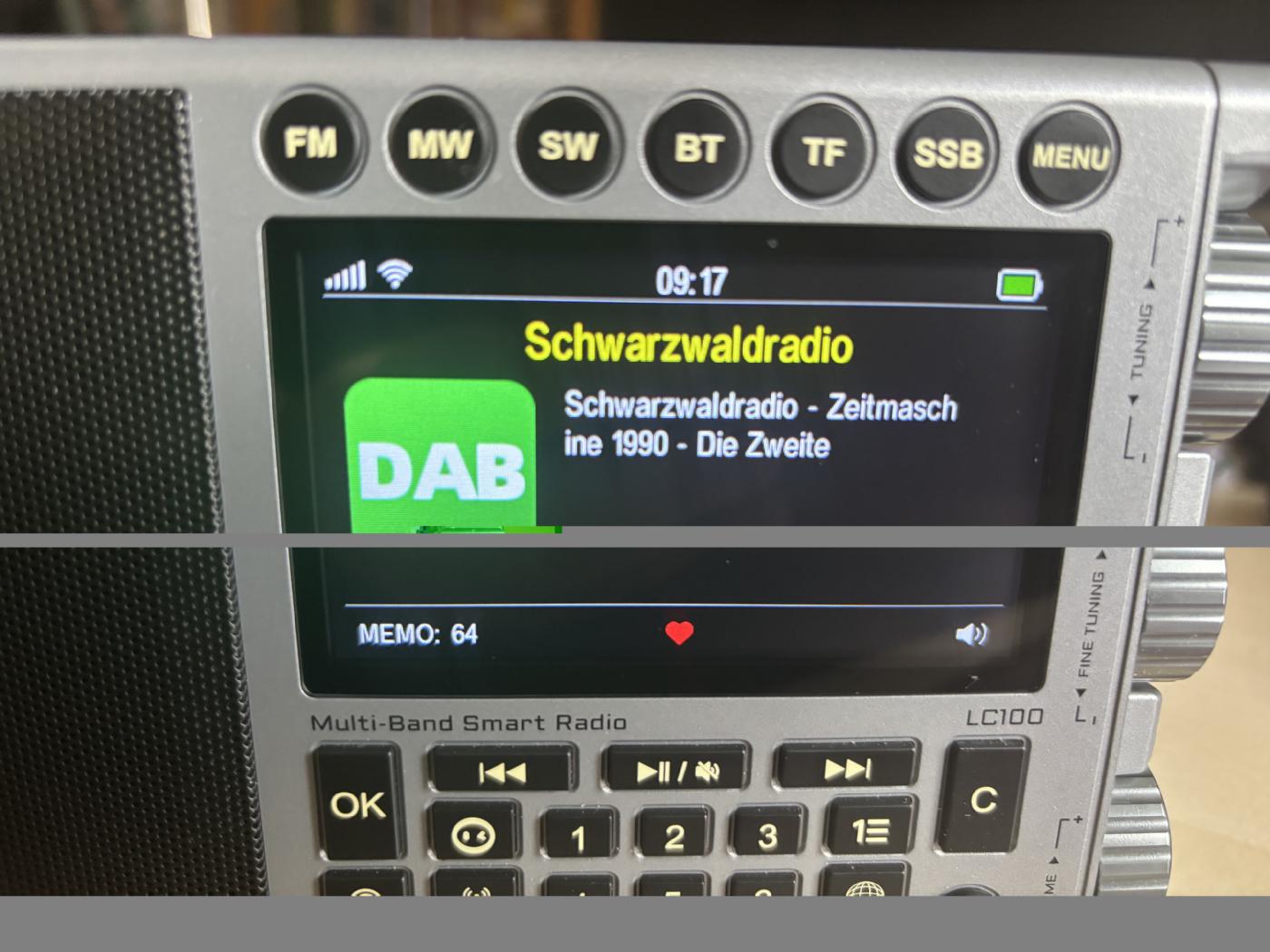
For the first time in radio history, there is now a world receiver capable of playing both Internet radio and DAB+ stations. The DAB function can be accessed either through the menu or by repeatedly pressing the FM button. When the FM button is held down, the LC-100 scans all available frequencies and saves the current list of stations. DAB+ reception is optimal even with the telescoping antenna extended to only 50% of its full length. The antenna’s orientation also affects reception. The display shows the station name and the currently playing track. The sound quality is very nice—it’s not bad, but it could still be improved. I can receive all locally available stations here, and even some stations from neighboring France can be heard. That’s something, at least!
Long Wave / Medium Wave
The LC100 can also receive long-wave and medium-wave broadcasts. The device features a built-in ferrite antenna for this purpose. Unusually, the telescopic antenna can also be used in conjunction with it, which significantly improves reception, especially outdoors.
Overall, reception on the medium and long waves has improved significantly compared to the LC90. Even small and very small stations, such as the museum radio from Bad Ischl, can now be received—provided you’re in an interference-free environment. It’s also worth noting that the LC100 features a jack for connecting an external antenna—which is particularly advantageous in the AM band. When I connect the device to my Wellbrook Loop, stations that were previously inaudible suddenly come through. Unfortunately, it’s a fact that here in Germany, you can only hear anything on the medium wave band after dark. The LC100’s medium-wave range extends from 522 to 1,710 kHz and can be tuned in steps of 1, 9, or 10 kHz. You can access the long-wave band by repeatedly pressing the MW button. The range extends from 153 kHz up to 279 kHz. Another great feature is the variable bandwidth for stations—a feature also available for the other analog bands.
Shortwave and SSB
The shortwave band extends seamlessly from 2,300 kHz to 29,999 kHz. Just like the other bands, the shortwave band can be tuned using rotary knobs or by entering frequencies directly. It also supports SSB reception—for both the upper (USB) and lower (LSB) sub-bands—which amateur radio enthusiasts are sure to appreciate. The adjustable bandwidth expands the possibilities even further. Even though some reviews claim otherwise, reception performance on shortwave with the built-in telescoping antenna is very good. In a direct comparison, neither the DP-666 nor the Grundig Satellit700 can keep up. AM stations with strong signals and good modulation sound particularly good. A local example here would be KBS World Radio on 3955 kHz. If you set the high bandwidth for this station, it sounds almost like an FM station. But even weak signals can usually be received quite well. Connecting a good external antenna also has an extremely positive effect on shortwave reception. For example, I was able to receive the small Mexican station XEPPM on 6185 KHz with a usable signal in the mornings on several consecutive days.
Conclusion
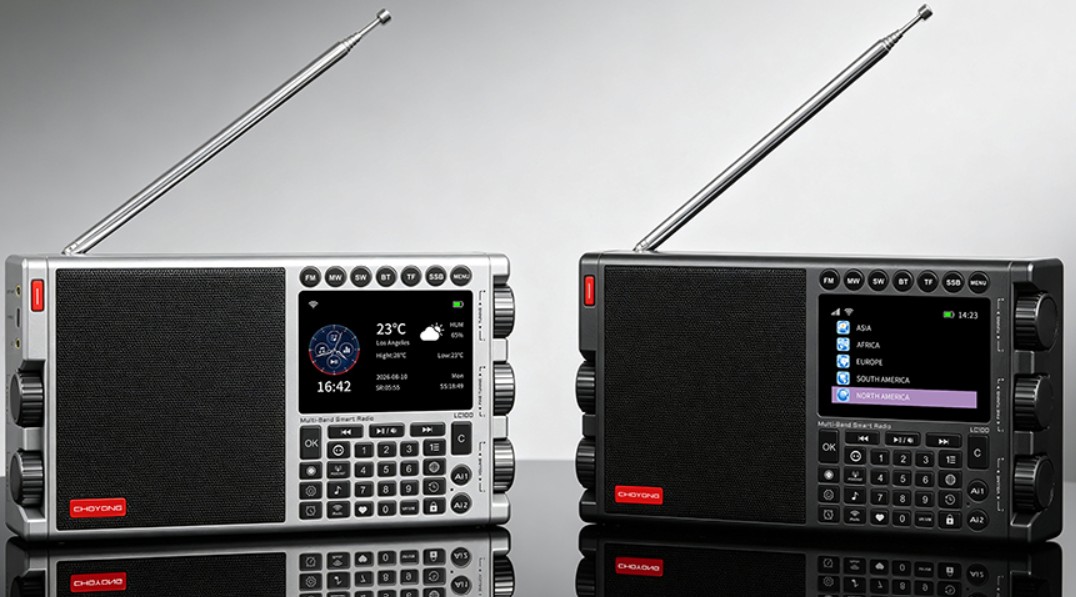
It was worth the wait. The LC100 without DAB+ is already available; the version with DAB+ featured here will be available for order from Choyong starting in late September, and a few weeks later on Amazon as well.
With the LC100, Choyong has really hit the jackpot. For me personally, it’s the best and most beautiful radio I’ve ever held in my hands. I find it hard time and again to tear myself away from this device—and with all its features, there’s always something that fascinates and captivates me. As a DXer, AM and FM are certainly my top priorities. But I also enthusiastically use the time archive, the music box feature, the internet radio with its massive database, and much more.

For more information, visit the Choyong website. The device is described there, and you can also order it:
https://www.choyongradio.com/
Radio is my passion. It has been a part of my life for as long as I can remember. Even back then, when I was taking my first steps into the world at home with my dad’s old tube radio, the radio had become a gateway to the world for me.
Who would have thought back then of all the possibilities we have today? Choyong has been on the European radio market for several years now. The products on display in Choyong’s radio shop are truly remarkable: Take the “Voyager,” for example—probably the world’s smallest internet radio. Clad in genuine nappa leather, the Maestro delivers a rich sound spectrum—and, to my knowledge, the LC90 was the world’s first world receiver featuring internet radio, a TF card, eSIM, and more.
Now Choyong has unveiled a radio that surpasses everything we’ve seen so far in many ways: The LC100—the successor to the already very capable LC90—is available in two versions: One version features DAB+ and was developed specifically for the European market and Brazil. The second version, which lacks DAB+ but is equipped with the TEF6686 chip, is intended for all those parts of the world where DAB+ is not available—and for dedicated FM wave hunters. The information provided here refers to the European version with DAB+.
Since there is currently no German-language user manual available, I am making it available here on my website.
The LC100 also comes in two different versions in terms of its exterior design: The all-black version resembles its predecessor, the LC90, in some respects. Personally, I particularly like the LC100 in the silver finish. While the LC90’s multifunctional knobs protrude from the right side of the device, they are integrated into the housing on the new LC100. In addition, there are now two knobs on the left side that allow the treble and bass to be adjusted independently of each other. A whole range of new features has been added, which will be discussed in detail below. The significantly larger display is particularly impressive. The radio detects its local location and displays the time, temperature, humidity, and sunrise and sunset times from the nearest weather station.
Not long ago, the LC90 was the world’s first radio to offer all the key features of a world receiver while also serving as a modern internet radio with podcasts, Bluetooth, and voice control. Firmware updates, which Choyong provides to its customers free of charge, also transformed the radio into an interactive jukebox—an audio device where you simply say the song title or the artist’s name, and the radio plays the track. Added to this were user interfaces in multiple languages, including German. With the LC100, there is now a radio that combines all these features. The German user interface will also be available soon. It’s impossible to summarize all the new features in just a few words. For the first time, there is now a world receiver with DAB+, a music box function, internet radio, podcasts, voice input, Bluetooth, a time archive, a recorder, and much more.
Internet Radio & Podcasts
Once you turn on the radio, you can immediately access the device’s analog functions: longwave, mediumwave, shortwave, and FM. However, to access online stations, the device must first connect to Wi-Fi and the internet—just like with the LC90—which can take a few seconds. The Wi-Fi capabilities have been significantly improved and accelerated compared to the LC90—and both Wi-Fi bands can now be used. Alternatively, you can also operate the LC100 with a SIM or eSIM. You can order the eSIM directly from Choyong, allowing the radio to function fully even without your own internet modem. Choyong maintains its own database where the online radio stations are hosted—and is therefore not reliant on third-party providers, which tend to disappear from the scene from time to time. The selection is enormous, and the stability is far greater than with any other provider. There are around 50,000 stations to choose from. If, despite the variety, you can’t find a specific station, you can easily add it yourself via an online interface. The stations are sorted by continent and country. German stations are organized by federal state. National stations, such as DLF and public broadcasters, are available in their own separate categories. In addition to the many internet radio stations, listeners will find a nearly limitless number of podcasts. You can select your preferred podcast language—including German—via the menu. For added convenience, there’s also a “Music” button to help you find stations or podcasts. The menu also allows you to select stations by categories such as “Interviews,” “Music,” “Technology,” and much more. And that’s not all: the LC100 also features voice control. This lets you “talk” to the radio and simply “call up” the station or podcast you want without having to type or fiddle with the controls. Commands like “BBC” or “Kontrafunk” search for stations and display them in a list of results, from which you can then select the station you want. To be fair, it should be noted that voice control doesn’t always work right away—which is sometimes due to the spoken word not always being interpreted correctly. Every now and then, it helped if I repeated the station name or said it in English. The sound quality of the LC100 is excellent—especially thanks to the new ability to adjust treble and bass separately and tailor the sound to your own preferences—always, of course, depending on the data rate of the currently tuned station.
A new feature on the LC100 is the option to access regionally available internet stations using a dedicated iRadio button. This is controlled via the device’s location search.
Stations you particularly enjoy and listen to frequently can be marked as favorites using the heart button and saved to a separate list, which can then be accessed via the “Menu” button. This also works for songs, podcasts, and analog services.
The Radio as a Jukebox
After pressing the Menu button and then “Search,” you can use voice input to start your search. First, you’ll need to decide whether you want to search for stations (Ai2), podcasts (Ai1), or music (MENU). Hold down the corresponding button, and when the microphone icon on the display starts flashing, say the name of the artist or composer you want to hear, then release the button. You should pronounce the name as clearly as possible, though—sometimes the name isn’t recognized. If the artist is found, the LC90 turns into a real music machine. You can choose from the selected artist’s repertoire—or simply let it play one track after another—automatically. The heart icon lets you save your selection as a favorite and recall it later by pressing the heart button. Over time, you can build up a real music library this way.
Bluetooth, TF, and Recorder Function
Once you’ve paired your radio with a Bluetooth device—such as a cell phone—you become your own program director and can conveniently play music files or YouTube audio. With the added ability to store and play music, podcasts, audiobooks, and more on a TF card, the possibilities offered by the radio are virtually limitless. The TF card must be formatted as FAT. According to the specifications, cards up to 32 GB are supported. In practice, however, much larger cards also work—I’ve personally tested a card with a full TB and had no issues.
The LC100 can now also record music tracks and DAB broadcasts. The tracks can then be easily edited and trimmed on a PC and compiled into your own playlist or CD. The recorder also works flawlessly with podcasts. This feature is not yet available for analog services such as shortwave (SW), medium wave (MW), or FM. If you press the record button in standby mode, ambient sounds are recorded—and you can even “speak into the recorder” yourself.
The Radio as a Time Machine
You’re in for a real surprise when you select the “Time Archive” option from the menu. The LC100’s display transforms, turning the radio into a real time machine. Here’s how it works: Use “OK” to select the language you want, and while holding down the “Tuning” knob, choose the year you’d like to travel to. Behind this feature is online.org, a massive collection of historical documents from the past. The journey through time begins in 1900 and ends today. Recordings from the selected year are then played at random. In addition to music, speeches, and sound recordings, you can also listen to entire radio plays and broadcasts. The selection is random, so you can look forward to new sounds every time. The display shows the selected year and language, as well as the currently playing track, the track’s duration, the audio type, and details about the track. You can use the forward, reverse, and pause buttons to navigate, skip tracks, or listen to them repeatedly.
After the welcome message, the display occasionally shows a timeout message following the initial startup, which you can skip by briefly pressing the “C” button.
FM
The FM frequency range extends from 64 MHz to 108 MHz—adjustable in 50, 100, and 200 kHz increments. You can also enter the frequency directly using the number pads. To set 88.5 MHz, enter 885 and wait 1 second; the frequency will then be active. The bandwidth can be widened or narrowed (while holding down the fine-tuning knob) from 56 to 311 kHz—depending on whether you want to listen to a particularly weak or a strong local station. Of course, you can also simply set it to “Auto,” which works almost every time.
For my tests and comparisons, I used the Grundig Satellit700 and the small Deepelec DP-666—which has excellent FM reception—as reference units. The LC100’s reception performance is indeed very good. It’s amazing what this unit can pick up with its 110-cm-long telescoping antenna. Even the Deepelec DP-666, with its TEF6686 chip, can’t keep up. And the Grundig Satellit700 certainly can’t. The sound quality of the stations played back is brilliant—especially at high bandwidth. In this regard, the Choyong LC100 is far superior to both reference units. The ability to individually adjust the treble and bass settings also has a very positive effect here.
Example: “Deutschlandradio Kultur” broadcasts at 200 watts from Berliner Allee in Freiburg im Breisgau and can be received here in Herbolzheim in northern Breisgau without any problems or interference. The same goes for “uniFM,” which broadcasts from the Freiburg University Hospital at 300 watts. Even “Freies Radio Wiesental,” broadcasting at 500 watts from 60 km away, was heavily noisy and plagued by interference on the DP-666, but came through crystal clear on the LC100 with a 56 kHz bandwidth. On the Grundig, the station was completely inaudible.
I particularly like the RDS feature on the LC100. I don’t know of any other radio that recognizes the name of the station being listened to in RDS so quickly. If the signal is strong enough, it takes no more than a second for the RDS name to appear on the display. After a brief wait, the program type appears, and finally, if available, the song currently playing.
DAB+
For the first time in radio history, there is now a world receiver capable of playing both Internet radio and DAB+ stations. The DAB function can be accessed either through the menu or by repeatedly pressing the FM button. When the FM button is held down, the LC-100 scans all available frequencies and saves the current list of stations. DAB+ reception is optimal even with the telescoping antenna extended to only 50% of its full length. The antenna’s orientation also affects reception. The display shows the station name and the currently playing track. The sound quality is very nice—it’s not bad, but it could still be improved. I can receive all locally available stations here, and even some stations from neighboring France can be heard. That’s something, at least!
Long Wave / Medium Wave
The LC100 can also receive long-wave and medium-wave broadcasts. The device features a built-in ferrite antenna for this purpose. Unusually, the telescopic antenna can also be used in conjunction with it, which significantly improves reception, especially outdoors.
Overall, reception on the medium and long waves has improved significantly compared to the LC90. Even small and very small stations, such as the museum radio from Bad Ischl, can now be received—provided you’re in an interference-free environment. It’s also worth noting that the LC100 features a jack for connecting an external antenna—which is particularly advantageous in the AM band. When I connect the device to my Wellbrook Loop, stations that were previously inaudible suddenly come through. Unfortunately, it’s a fact that here in Germany, you can only hear anything on the medium wave band after dark. The LC100’s medium-wave range extends from 522 to 1,710 kHz and can be tuned in steps of 1, 9, or 10 kHz. You can access the long-wave band by repeatedly pressing the MW button. The range extends from 153 kHz up to 279 kHz. Another great feature is the variable bandwidth for stations—a feature also available for the other analog bands.
Shortwave and SSB
The shortwave band extends seamlessly from 2,300 kHz to 29,999 kHz. Just like the other bands, the shortwave band can be tuned using rotary knobs or by entering frequencies directly. It also supports SSB reception—for both the upper (USB) and lower (LSB) sub-bands—which amateur radio enthusiasts are sure to appreciate. The adjustable bandwidth expands the possibilities even further. Even though some reviews claim otherwise, reception performance on shortwave with the built-in telescoping antenna is very good. In a direct comparison, neither the DP-666 nor the Grundig Satellit700 can keep up. AM stations with strong signals and good modulation sound particularly good. A local example here would be KBS World Radio on 3955 kHz. If you set the high bandwidth for this station, it sounds almost like an FM station. But even weak signals can usually be received quite well. Connecting a good external antenna also has an extremely positive effect on shortwave reception. For example, I was able to receive the small Mexican station XEPPM on 6185 KHz with a usable signal in the mornings on several consecutive days.
Conclusion
It was worth the wait. The LC100 without DAB+ is already available; the version with DAB+ featured here will be available for order from Choyong starting in late September, and a few weeks later on Amazon as well.
With the LC100, Choyong has really hit the jackpot. For me personally, it’s the best and most beautiful radio I’ve ever held in my hands. I find it hard time and again to tear myself away from this device—and with all its features, there’s always something that fascinates and captivates me. As a DXer, AM and FM are certainly my top priorities. But I also enthusiastically use the time archive, the music box feature, the internet radio with its massive database, and much more.
For more information, visit the Choyong website. The device is described there, and you can also order it:
https://www.choyongradio.com/